
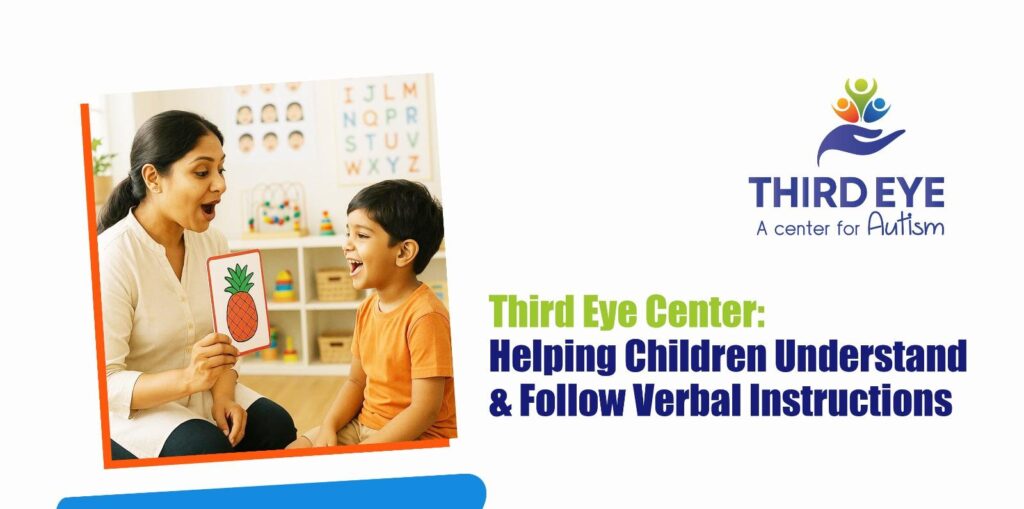
Children should be familiar with following a detailed spoken instruction.
Instructions like: “come here”, “keep the book on the table,” or “put your shoes away” involve the child listening carefully and comprehending instructions, recalling what is necessary, and effectively acting.
For some children, these steps may be difficult – especially if instructions are too long, unclear, or provided in a distracting environment.
Third Eye Centre offers help and support for children with an educational approach based on their talents and needs. We operate as an autism-specific educational setting, emphasizing that our role is to help children grow, learn, and develop.
Find further information about Third Eye Center on their website.
Table of Contents
ToggleWhy Do Some Children Find Verbal Instructions Difficult?
There are many skills involved in understanding what is said.
A child may need to:
- Pay close attention to the statements.
- Know what the instruction means.
- Process this information.
- Carry out the instructions.
- Complete the action as instructed.
- Ask for clarification if needed.
How Third Eye Center Supports Learning
Learning can be adapted to the ability and needs of each child at Third Eye Centre.
The centre emphasises developing complementary learning and supporting the whole child. The centre follows an approach based on building on the strengths of individual children and enabling each child to succeed.
1.Breaking Instructions into Smaller Steps
Sometimes a longer instruction can be confusing.
Breaking down the activity into bite-sized chunks simplifies the process a little for the child.
For example:
Instead of:
“First of all, you need to get your bag, open your bag, get your notebook, and place it on the table.”
Try:
- Grab your bag.
- Unpack your bag.
- Get your notebook.
- Place it on the table.
This provides the child with one action at a time.
2. Using Clear and Simple Language
Communication that is clear can help you follow instructions easily.
Using short and familiar words to give the instruction may help children concentrate on the relevant part of the instruction.
The adult may also make lengthy pauses so that the child is able to comprehend what has just been said and then repeats the instruction.
3. Supporting Attention and Listening
Before providing an instruction, it may be helpful to capture the child’s attention.
Ways to improve listening include speaking clearly, eliminating distractions, and using the child’s name.
What we are not trying to do is modify the instruction so that a child will repeat it. We are trying to promote good understanding and response.
4. Using Visual Support
For some children, verbal information is more accessible if there is visual support available.
Visual support may include:
- Pictures
- Objects
- Written words
- Demonstrations
- Visual schedules
- Step-by-step activity cards.
Integrating both verbal and visual information is an additional way a child can learn about an activity.
5. Encouraging Independent Responses
Children can be encouraged bit-by-bit to carry out familiar instructions with decreasing help.
For example, a learning activity might be supported at the start, but then the child is encouraged to do tasks in fewer steps.
This can contribute to skills that can be applied in daily life.
Everyday Situations Where Verbal Instructions Matter
Interpreting instructions is thus beneficial in many everyday instances.
Situation | Example Instruction |
Home | “Put your toys in the box.” |
School | “Open your notebooks.” |
Personal care | “Wash your hands.” |
Play | “Pass the ball to your friend.” |
Travel | “Come over here and stand.” |
Classroom activity | “Colour the picture.” |
Regular practice can enable children to become comfortable with listening and responding in normal daily activities.
Supporting Children Without Pressure
All children are born to learn.
When a child does not echo an instruction given to them, repeating these words multiple times may not always work better than using a different approach.
- Give the child more time to process the instruction.
- Give one instruction at a time.
- Apply visual aids.
- Showcase the task.
- Extend the time for processing.
- Offer suitable support.
- Practise skills in familiar activities.
Quick Tips for Parents
Parents can also practise their verbal interaction skills in day-to-day situations.
- Write brief and simple instructions.
- Use common words.
- Designate a workspace.
- Allow some time for the child.
- Incorporate visuals when appropriate.
- Praise appropriate efforts.
- Practise one skill at a time.
- Keep a regular schedule.
FAQ
- Why does my child struggle to follow verbal instructions?
Children may have problems with attention, understanding, auditory skills, memory, or sequencing. An evaluation by a professional can determine which area requires support.
- How can I make instructions easier for my child?
Use short sentences, focus on a single step at a time, minimise distractions, model the activity, and use visual cues when possible.
- Are visual instructions helpful?
Visual aids may help some children, as the information remains after the instruction has been spoken.
- How can Third Eye Centre support my child?
Childmindedness is a term used by Third Eye Center, who also state that they work with the child’s abilities, strengths, and individual learning needs.
Conclusion
Learning to comprehend and follow oral directions, including understanding and following spoken directions, instructions, and commands, can help enable a child to communicate, participate independently in classroom activities, and manage daily life.
Using the right support, practice, and time, children can develop the skills to confidently be part of daily routines.
Third Eye Centre offers a setting that aims to learn about children and their abilities, as well as to enhance and support their learning.