
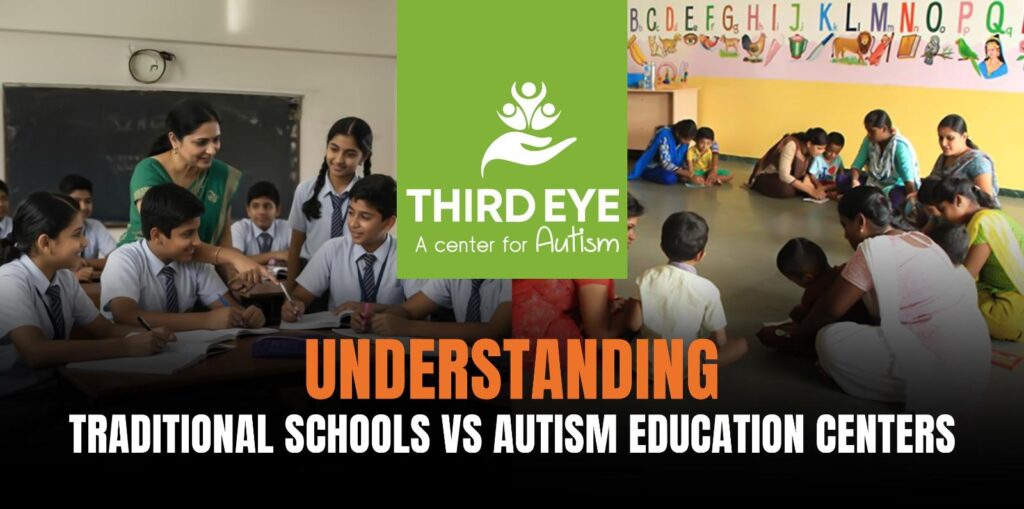
All children are entitled to an education which is tailored to a child‘s unique learning style, developmental needs and abilities. Schools can offer a good quality education but there are some children with autism who may benefit from placing in a special school which caters for their particular needs.
Learning about the distinctions between traditional schools and autism education centers will allow parents to better explore options suitable to their child‘s needs. At third eye, the main goal is to provide a tailored learning environment that will best assist a neuro-diverse child in developing skills in the areas of communication, socializing, academics, and life skills.
Table of Contents
ToggleTraditional Schools vs. Autism Education Centers at a Glance
Feature | Traditional Schools | Autism Education Centers |
Learning Approach | Standard curriculum | Individualized learning plans |
Class Size | Usually larger | Smaller student-to-teacher ratio |
Teaching Style | Same pacing for most students | Customized to each learner |
Communication Support | General classroom instruction | Specialized communication programs |
Sensory Support | Limited | Sensory-friendly environment |
Skill Development | Academic-focused | Academic, social, behavioral and life skills |
Name of a Traditional School
Conventional schools follow a timetable consisting of specializations, which are planned to satisfy the requirements of a schoolbook. Teachers usually teach the whole class and the students learn at roughly the same time.
Traditional schools typically offer:
- Standard academic curriculum
- Classroom-based instruction
- Group learning activities
- Regular assessments
- Extracurricular programs
- Social interaction with peers
While most children flourish in this setting, some of our autistic learners may need a greater level of support.
What Is an Autism Education Center?
An autism education center applies education in the way that works best with the way in which autistic children learn. Autism education centers provide instruction with developmental supports in place and employ research-based interventions and curricula.
At Third Eye Center, instruction is planned around the individual child‘s strengths, interests, communication skills and developmental goals.
Key features include:
- Individualized Education Plans (IEPs)
- Small class sizes
- Personalized learning goals
- Speech and communication support
- Behavioral guidance
- Social skills development
- Family collaboration
Individualized Learning Makes the Difference
A major difference between typical schools and the autism education centers is the mode of learning.
In a traditional school, all children are usually taught the same lesson plan to the whole class. An autism education center prepares lessons based on each child‘s learning style.
Personalized learning helps children:
- Understand concepts more easily
- Build confidence
- Reduce frustration
- Improve participation
- Celebrate individual progress
This approach works with the understanding that all autistic learners are different.
Smaller Class Sizes Mean More Individual Attention
Autism education centers typically have fewer students per staff member.
Benefits include:
- Personalized instruction
- Better observation of progress
- Immediate support when needed
- Stronger teacher-student relationships
- Reduced classroom distractions
This added focus enables children to learn at a more comfortable pace.
Communication and Social Development
Communication is an integral part of gaining knowledge and daily life. Many autism education settings deem communication to be of great importance to the development of both verbal and nonverbal communication skills.
Students may participate in activities that improve:
- Expressive language
- Listening skills
- Social conversations
- Eye contact
- Emotional expression
- Peer interaction
School readiness skills enable children to become self-assured in school, at home and within the community.
Sensory-Friendly Learning Environment
Many autistic children are sensitive to sensory stimuli such as sound and touch.
Autism school programs use reduction of extraneous stimulation while at the same time making a sense of security for children.
Supportive features may include:
- Structured routines
- Calm classrooms
- Predictable schedules
- Flexible learning spaces
- Sensory-aware teaching strategies
These improvements help them stay interested and concentrated.
Building Independence Beyond Academics
Academics are still a priority, but the autism education centers also stress independent living skills.
Children learn skills such as:
- Daily living routines
- Decision-making
- Problem-solving
- Self-care
- Time management
- Emotional regulation
- Community participation
These experiences give students more independence in the future.
Family Involvement Matters
Parents have a crucial involvement in every childs learning.
The Center for education about autism promotes interaction between families and teachers. The aim is to facilitate learning outside of the school environment.
Family collaboration helps:
- Reinforce learning at home
- Track developmental progress
- Address challenges early
- Maintain consistent learning strategies
- Celebrate achievements together
This is a long-term viable path for success.
Choosing the Right Learning Environment
Each child is unique and as such there is not a single educational environment that suits everyone.
When selecting a learning environment, parents should consider:
- Individual learning needs
- Communication abilities
- Social development goals
- Sensory preferences
- Available support services
- Long-term educational objectives
The best choice is one that is going to make the child feel comfortable, confident and eager to learn.
Conclusion
Different Benefits Of Conventional Schools And Autism Education Centers. There are benefits in both the conventional schools and autism education centres. It depends upon the individual characteristics of that kid in terms of capability, growth and learning.
Through facilitating optimum learning environments for autistic learners at the physical and individual level in addition to working with families in a collaborative fashion, Third Eye Center ensures that the unique individual autistic learner can flourish by providing customized education and communication programs, enhancement of social and related skills, and close family involvement.
FAQ
1. What is the main difference between traditional schools and autism education centers?
In conventional schools, only one curriculum is implemented for all pupils; however, in autism education centers, one to one learning schedules and special help are designed for every child according to their own circumstances.
2. Why do some autistic children benefit from specialized education centers?
Specialized centers provide for smaller class sizes, focused instruction, communication assistance, sensory friendly settings, and developmentally appropriate activities that may more closely follow children‘s development and learning style.
3. Are academics included in autism education centers?
Yes. In addition to academics, the autism education centers teach communication, social skills, behavior training, and life skills.
4. How do autism education centers involve parents?
Parents work in conjunction with teachers through ongoing communication, monitoring of progress and solutions such as activities carried out at home to promote and consolidate developments.
5. How can parents choose the right educational setting?
Before choosing a programme for their child, parents should take into account the child‘s strengths and weaknesses, communication skills, developmental goals, support needs and learning environment.